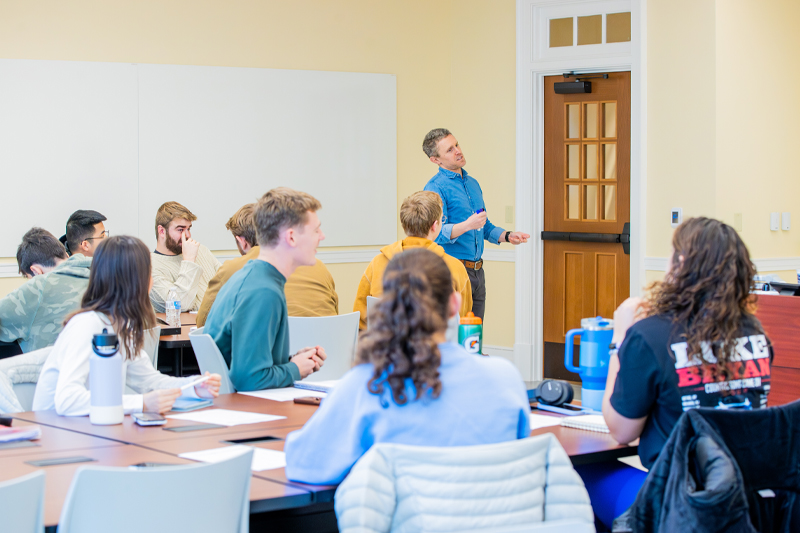
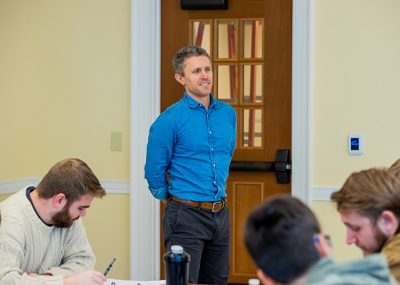
Dr. Matthew Morena has figured out the winning formula for making math enticing, doable, and applicable to Captains.
Morena teaches math concepts by putting them into action to solve real-world problems. This approach, he feels, breaks down barriers and makes math less intimidating and frustrating. It is clearly working, judging by the countless number of CNU students who have discovered a love of math in Morena’s classes and subsequently used it to launch successful careers.
His innovative teaching techniques, along with his contagious passion for math, have earned him a prestigious award: the Mathematical Association of America’s John M. Smith Award for Distinguished College or University Teaching for 2025. The award honors professors who "have been widely recognized as extraordinarily successful and whose teaching effectiveness has been shown to have had influence beyond their own institutions.”
Morena, an associate professor in the Department of Mathematics, is the first CNU professor ever to receive the award.
“It is a meaningful recognition–not just for me, but for the University,” he said. “I think it says something important about the kind of teaching that happens here. It shows that we take creativity, rigor, and student connection seriously. I am proud CNU is being recognized in these ways.”
To make his classes as interesting as possible, Morena is constantly in search of fresh ideas to explain and illustrate mathematical concepts.
“I try to make my classes high-energy and high-impact- something that feels like an experience, not just a lecture,” he said. “I spend a lot of time thinking about how to connect mathematics to students’ lives and long-term goals. And I’m not afraid to experiment. I’ve done fractal hikes, community partnership projects, even frisbee relays to help abstract concepts seem concrete. I like bringing in ideas that make students see math differently.”
Morena’s math journey began in earnest in college when he recognized that he enjoyed explaining things to classmates.
“It kind of grew from there. Over time, I realized this let me contribute in a lot of different ways,” he said. “I could help others learn how to think logically and analytically. I could dive into interesting problems. And I could pay it forward by teaching future teachers - people who might go on to inspire the next generation. That ripple effect really means something to me.”
That ripple effect has grown exponentially at CNU, as he has impacted students who also never expected to enjoy or pursue math. Helping them arrive at that ‘aha’ math moment, where everything clicks, brings Morena an overwhelming sense of gratification and purpose.
“I hope students leave with more confidence in their own thinking. Math is often dismissed as you either ‘get’ it or don’t, but I don’t buy that. I want students to see that this is a skill they can develop. If they walk away from my class with more curiosity, more creativity, maybe even a little joy, I’ve done my job,” he said.
It is not the first time Morena has been recognized for his success in the classroom. In 2024, he received the CNU Faculty Excellence Award in Teaching.
Morena joined the CNU faculty in 2017 and has since taught 19 math courses, including a community-engaged learning course he designed called BIG (Business, Industry, and Government) Experiences in Math in which students apply their math skills to solve open-ended problems proposed by local organizations and businesses.
“The BIG Math course reflects several of the most important priorities on our campus today—experiential learning, interdisciplinary work, and meaningful student engagement in the community. Students and partners collaborate on real needs identified by the community. These projects have real meaning for our partners,” Morena said.
For one of the projects, students worked with a local agency to conduct a cost benefit analysis of becoming a Medicaid provider for dental services, something that could dramatically expand access for low-income patients.
“It’s not a canned case study—it’s real, messy, applied work that makes mathematics feel both relevant and urgent. Students see how the math they’re learning connects directly to real-world questions, and the organizations gain something tangible and valuable in return,” he said. “It’s a win-win, and for many students, it’s the first time they realize they can use what they know to make a difference in their community.”