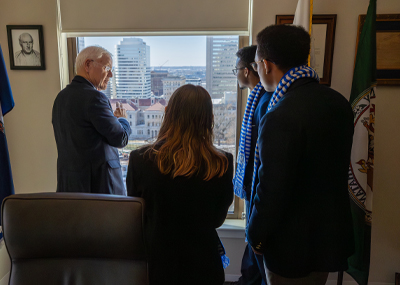
It was a moment that three Christopher Newport University students will always remember. They were in state Del. Lee Ware’s corner office overlooking the State Capitol in Richmond. First, he answered their questions during a friendly conversation. Then the Republican from Powhatan County stood up and summoned them to the big picture windows that are one of the perks of 28 years of service in the General Assembly. The students, mesmerized, listened as the former high school government teacher pointed to each building and shared a bit of its history. That sort of interaction, spontaneous and inspiring, is what Captains in the Capital is all about.
For six years now, the Wason Center for Civic Leadership has organized a daylong trip to Virginia’s Capitol complex. It’s an introduction to lawmaking, lawmakers, and lobbying at a breakneck pace. This year, 35 students with a range of academic interests filled the CNU bus. The group included members of the President’s Leadership Program, the Student Government Association, and Wason Scholars Program. The Captains were all instantly visible throughout the day wearing their distinctive scarves in CNU colors.
First stop was a conference room on the top floor of the General Assembly Building. President William G. Kelly, Rector Christy Morton, and Board of Visitors Secretary Brent Archer briefed the students. They were to follow an agenda carefully constructed by Wason Center leaders Dr. Rebecca Bromley-Trujillo, Cami Castleberry, and Jillian Hamilton in partnership with Tom Kramer, associate vice president for external relations and the University’s liaison with legislators.
“You have a great story to tell about Christopher Newport University,” Rector Morton said as the students prepared to fan out and meet individually with delegates and senators. “As you walk around, don’t forget to look around,” said Secretary Archer.. “You will be walking the same stairs as George Washington and Thomas Jefferson.”
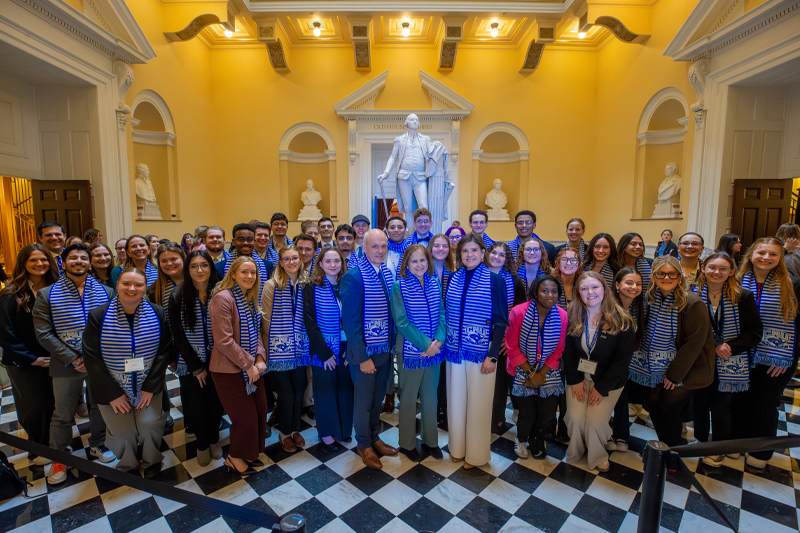
A regular presence in the Capitol as an expert on Virginia’s energy industry, Secretary Archer urged the students to admire the remarkable detail on the historic sculpture of Washington that has stood in the rotunda since the 1790s. Later in the day, the sculpture would be the backdrop for a group photo of the CNU delegation with Lt. Gov. Ghazala Hashmi.
After their meetings with individual lawmakers, the students were on the move again. The delegation was divided into two groups, one attending the opening of the House session and the other in the Senate chamber where they were introduced by fellow scarf-wearing state Sen. Danny Diggs. The campus is located in his district.
With President Kelly and the students standing, Lt. Gov. Hashmi, in her role as presiding officer of the state Senate, said, “I see the Senator is sporting the CNU scarf proudly and if we do spot other scarves as we walk through the halls, we will know to acknowledge the representatives of CNU. Thank you for the work of the institution and all that you are doing.”
As that unfolded in the Senate, state delegates Shelly Simonds and Jeion Ward '95 introduced the CNU group in the House of Delegates. As the action in the chambers continued, the students headed to lunch at the McGuireWoods law office with Wason Center Advisory Board Member Jackie Stone and Shannon Pierce, a member of the CNU Board of Visitors and President of Virginia Natural Gas. They were joined by eight Captains for Life who work at the Capitol complex and nearby.
Coincidentally, the extent of the University’s connection with state government was on display on the same day as the Captains in the Capital visit. Social Work Professor Dr. Diane Griffiths was leading a delegation of social policy students for Social Work Advocacy Day. They had studied the legislative process, selected and researched a proposed bill, built an advocacy plan for it, and then arranged meetings with delegates and senators and their staff.