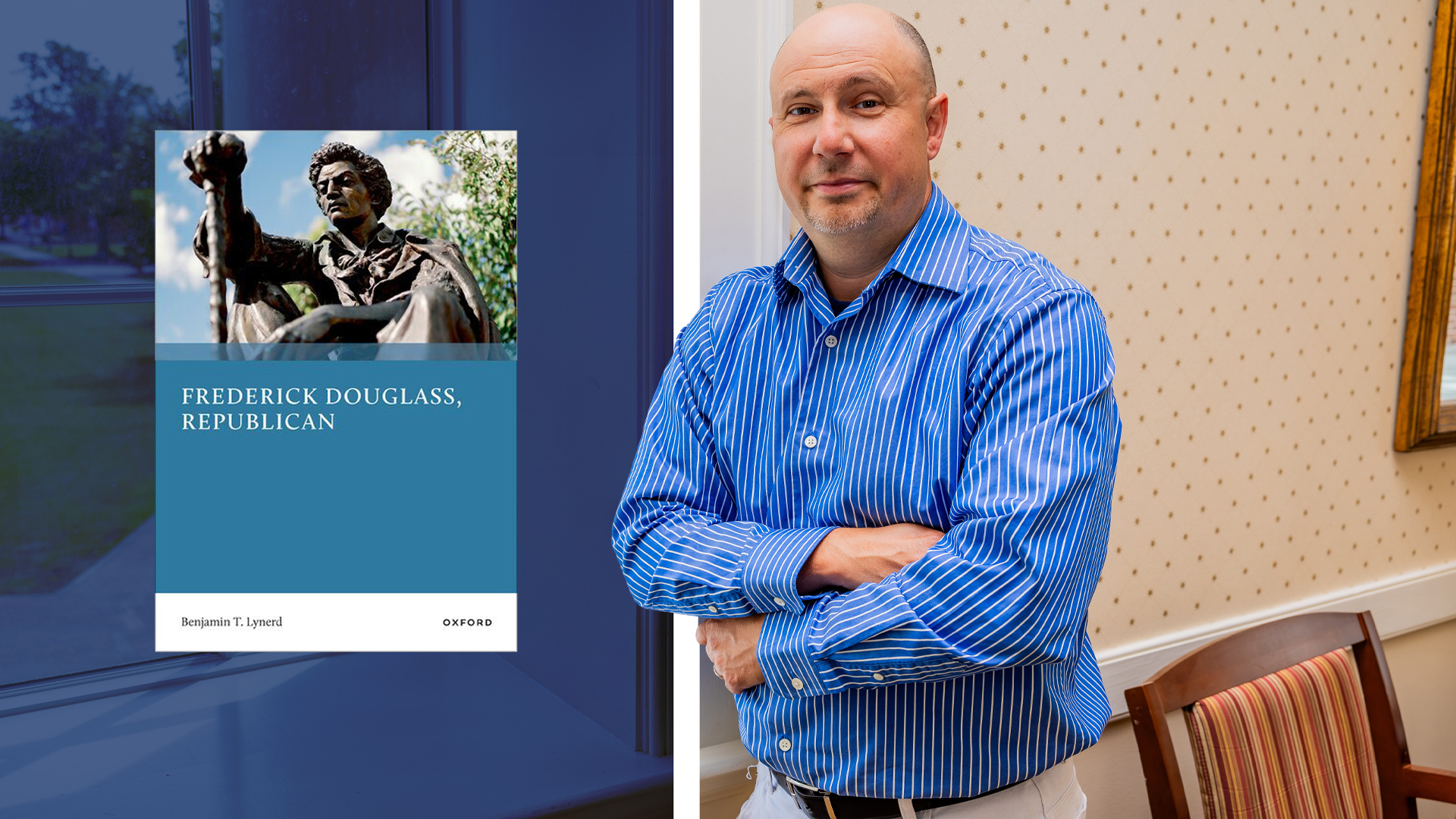
Most know Frederick Douglass as one of the country’s most influential abolitionists. But in his new book, Dr. Benjamin Lynerd, associate professor of political science, invites students and readers to explore Douglass’s work in the years following Juneteenth, which marked the arrival of freedom from slavery in Texas, and focused on building a society where all people could live freely, participate in democracy, and determine their own future.
Tell us about your new book, “Frederick Douglass, Republican” and your thoughts on its publication date being Juneteenth?
It's poetic. Unlike any other holiday on our calendar, Juneteenth captures the liminality of freedom in America: People who were technically eligible for emancipation on January 1, 1863, learned about it for the first time on June 19, 1865. If there is one issue that Douglass wrestled with more than any other in his 50-year public career, it was the challenge of effectuating a mass emancipation after centuries of a comprehensive subjugation. He knew very well that it could never be done with an executive order, a law, or even a constitutional amendment. It would require sustained reforms at every level of American society – the economy, the electoral system, and above all, the culture.
What inspired you to examine Douglass through the lens of the Black Republican tradition?
Douglass is usually situated within the thought world of 19th-century white Americans when, in fact, he both drew from and built upon a distinctive discourse on the meaning of freedom that took shape among thinkers of color throughout that century.
What is the Black Republican tradition, and why is it important to understand in terms of citizenship rights, economic independence, and opposing slavery?
Political theorists today are just beginning to grapple with this incredibly rich tradition that encompassed dozens of prolific writers throughout the 19th century. What is distinctive about black republicanism is its commitment, on the one hand, to the ancient republican ideals of an independent citizenry, civic virtue, and the integrity of the body politic, and, on the other, to wrestling with the unique affronts to these ideals in the European settlement of the Americas. At the intersection of these commitments stands a vibrant framework for overcoming these challenges and achieving a more just society.
Were there any discoveries in your research into Douglass’s writings that surprised you or will perhaps surprise your readers?
Probably Douglass’s interest in world history and current international news. I knew going into the project that Douglass was a voracious reader, but after spending so much time in his writings, I was struck by the breadth of his interests and his desire to understand his own experience in light of a larger narrative.
What do you hope your readers and students will better understand about Douglass after reading your book?
Douglass was a complex thinker with his own blind spots and flaws. We can learn a lot from thoughtful people even when, in retrospect, they got some things wrong.
How do Douglass’s ideas about freedom and citizenship speak to issues of racial justice today?
Sorry to say (spoiler alert) that Douglass died in 1895, deeply discouraged about the prospects of building a healthy, integrated republic, and even more discouraged about the future for black Americans. I even argue in the book that black republicanism itself took a big hit, not just in terms of racial justice but in terms of the economic independence of American citizens in general. That said, I also think this tradition still offers the clearest, most complete, and most forward-looking framework for building a just society, one that begins with ordinary people understanding more deeply what it means to live in freedom. It has been humbling and enriching to spend the last five years of my life immersed in these incredible texts.