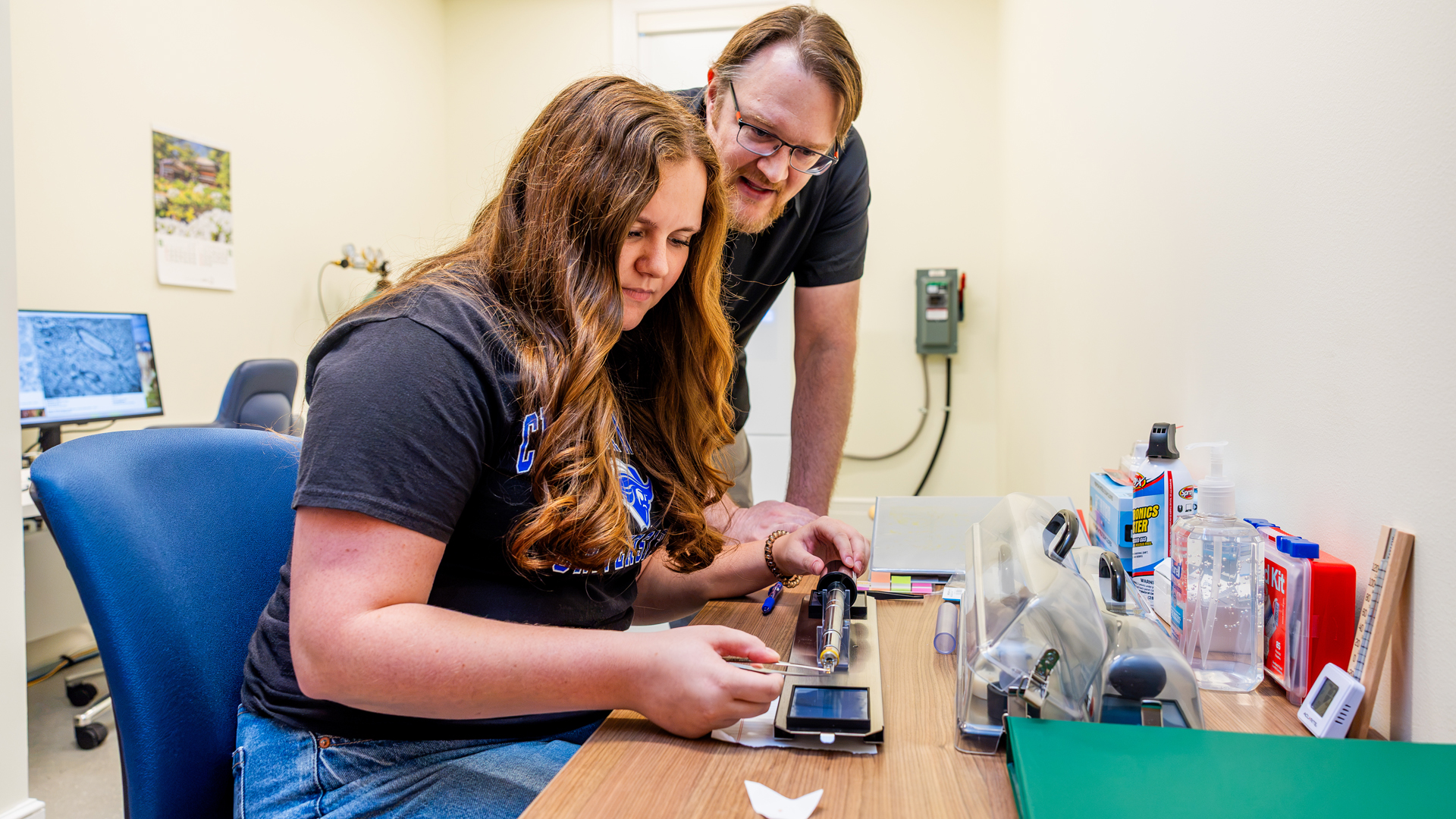
When Payten Gary arrived at CNU as a freshman, she knew neuroscience was her passion, but she did not know exactly how she could turn it into a career.
That quickly changed when she met Christopher Newport neuroscience professor Dr. James Bogenpohl. Among the topics his lab studies: the effect alcohol has on the brains of mice.
Gary, ‘28 Neuroscience, was enthralled with the research, and after working in Bogenpohl’s lab, applied to participate in a unique CNU program, Summer Scholars, so she could deepen her scientific knowledge and experience.
As a Summer Scholar, she took a leadership role in the lab’s alcohol project and flourished. Her world shifted as she realized what moved her and she felt her career path and goals being recast in real time.
“This program has made my CNU experience more meaningful by allowing me to connect what I learn in the classroom with the process of scientific discovery,” she said. “It has allowed me to gain hands-on experience with specialized laboratory techniques while applying what I learn as a neuroscience major in a real-world research setting.”
Summer Scholars is a collaborative CNU program offered through the Office of Research and Creative Activity (ORCA) that pairs students with faculty to conduct paid research often resulting in published results and a boost on the career track.
“Having a full-time research student during the summer allows the professors to give them a lot more time and attention than would be possible during the semester, and students get experience in an environment that mimics graduate school or a full-time job in research,” Bogenpohl said. “Such experiences often lead to authorship on scientific publications, and they are highly valued by graduate schools and future employers."
Research is a high priority on campus, and is one of the Four Pillars of a CNU education. It also strongly aligns with the University’s Strategic Compass priority of connecting with the local community.
“Through this experience, I have realized I can contribute to healthcare and improve people’s lives without necessarily working on the clinical side,” Gary said. “I have discovered how much I enjoy asking scientific questions, designing experiments, learning new techniques and contributing to a larger research project.”
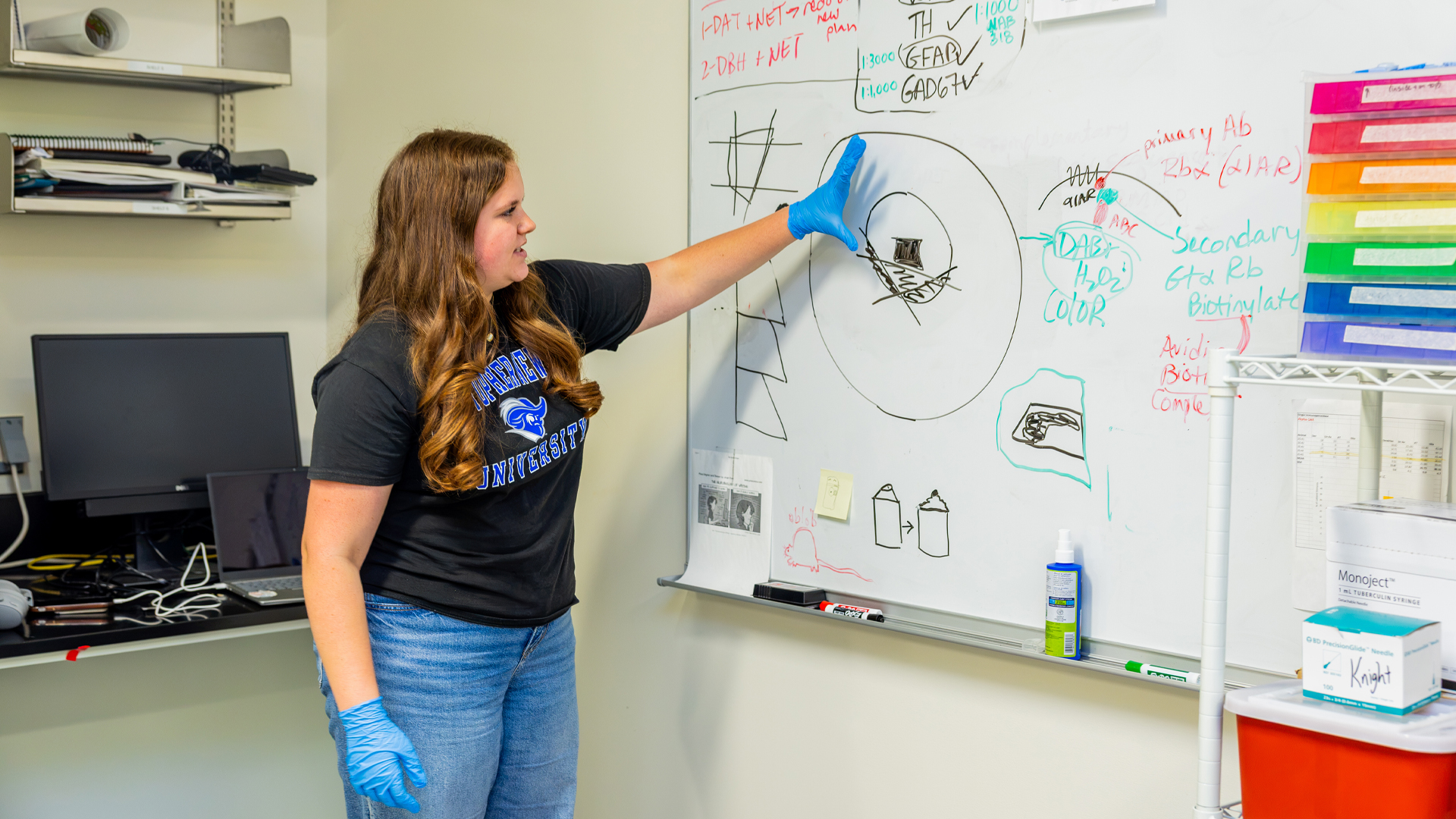
Gary spent the summer studying how alcohol impacts the ultrastructure of myelin in the brain. Myelin is the protective covering surrounding nerve fibers and is critical to communication between different areas of the brain. The research is focused on whether a specific gene, Clic4, regulates alcohol-induced damage to myelin.
Using cutting-edge technology to compare the brains of mice who were exposed to alcohol to mice that were not, she was able to see firsthand how alcohol harms the brain.
“This research is important because alcohol can have widespread effects on individuals, families, and communities, yet there is still so much to learn about how it affects the brain at the cellular level,” Gary said.
The hope, she said, is that the research will create a strong basis for more extensive studies in the future. In fact, Gary’s project is the kickoff of a larger related research project that will continue in Bogenpohl’s lab through the school year.
“I hope this work contributes to a larger understanding of the relationship between alcohol exposure, genetics, and brain structure. The current project can establish a foundation for comparing control mice with genetically modified mice in the future,” Gary said. “These comparisons may help determine whether certain genetic factors make the brain more vulnerable or resistant to alcohol-related changes. Ultimately, I hope this line of research contributes to a better understanding of individual differences in the effects of alcohol and supports future work related to prevention, recovery, and treatment."
The Summer Scholars research informed Gary’s CNU journey, allowing her to see outside of the classroom and have experiences usually reserved for graduate students at other universities. It provides a wide perspective of what’s possible and allows students to become more confident.
“Summer scholars are often trusted with more complex techniques in the lab, and they usually go on to become student leaders in their respective research groups,” Bogenpohl said.
For Gary, the program proved to her that conducting research was exactly what she wanted to do now, and in the future.
“Research is important for undergraduate students because it teaches skills that cannot be fully developed inside the classroom. It can help students better understand their interests and career goals and provides an opportunity to explore what working in a particular field is actually like. Research reaches students that science is not always a straightforward process, and allows them to become a better critical thinker and problem solver,” she said.
Gary plans to earn a doctorate in neuroscience or genetics and pursue a career in biomedical research, a trajectory that she will embark on in large part because of her research with Bogenpohl.
“I am particularly interested in studying how changes at the cellular and genetic levels contribute to neurological conditions and influence behavior,” she said. “I hope to conduct research that improves our understanding of substance abuse disorder and how it affects individuals.”