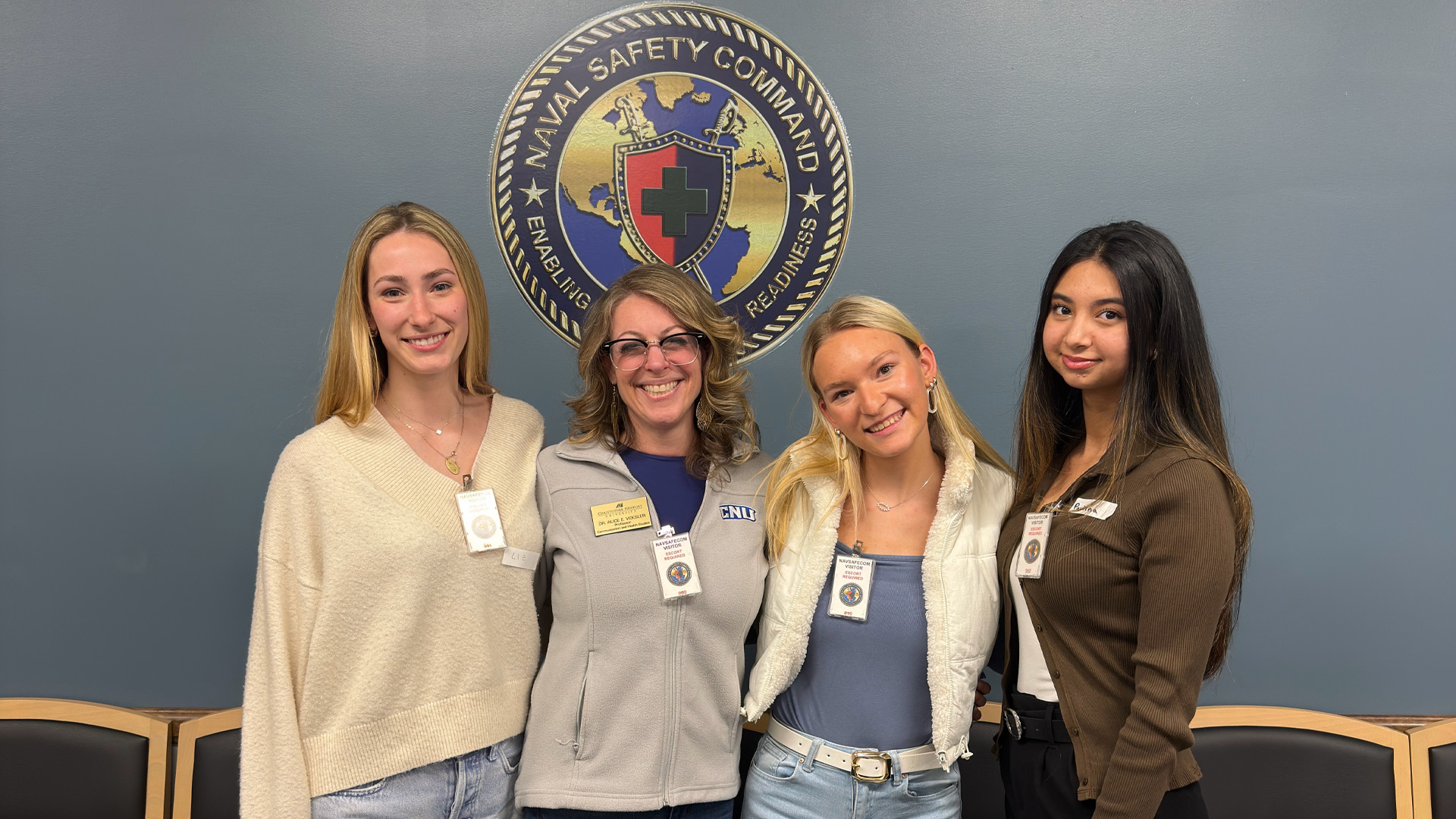
Christopher Newport students are working to reverse a deadly trend affecting U.S. Sailors and Marines: motorcycle accidents.
They’re using research, along with their communication and public health training, to help members of the military ride more safely.
According to the Naval Safety Command, 30 Sailors and 15 Marines died in motorcycle crashes during fiscal year 2025 – the worst fatality numbers since fiscal year 2008. This steep rise in preventable deaths severely degrades naval readiness, thus compromising the Navy and Marine Corps’ ability to quickly and successfully execute the mission.
“This is critical work,” said Dr. Alice Veksler, Health Studies program director. “The students love it because they are actually getting to do something real. This gives them lots of opportunities to practice skills they’re learning in the classroom in the real world.”
The students are working with data and research analysts at Naval Safety Command (NAVSAFECOM) to create a far-reaching creative campaign they hope will speak to young riders, the group most likely to take risks on their motorcycles. The messaging is clear and simple: gear up with helmets and other safety equipment, slow down, and be cautious.
In partnership with NAVSAFECOM and Naval Station Norfolk, the first set of focus groups with military riders conducted by the students are complete and more groups are in progress.
“This project requires us to expand our perspective. We are not only looking at [Naval Station] Norfolk, we are trying to influence the entire military’s population of young motorcycle riders. We have used creative thinking, adaptability, and the ability to create something that highlights the one thing all of these individuals have in common: the passion for their bikes,” said Elizabeth McBee ’27 Cellular, Molecular and Physiological Biology.
When Veksler learned about the issue, she connected with a colleague at NAVSAFECOM and brought students from her Health Communication and Public Health classes into the effort to help develop a solution.
Their work now focuses on young military personnel stationed around the globe.
“I feel like it is almost an obligation in a way. I have received an education that equips me with the tools to influence lives, so I should use them to the best of my ability,” McBee said. “With family in the military, this project also hits a little closer to home. Unfortunately, I have also been able to see the impact the loss of a loved one can have on a family. I simply want to help those, even if it only changes one person’s mind, to live the lives they were meant to, because I don’t believe their story should end on the pavement.”
The project is driven by research. Students used the focus groups with Sailors and Marines to gather information about their riding habits and attitudes toward motorcycle safety. The focus group participants then provided feedback on the students’ campaign ideas and proposed safety slogans, such as, “Two wheels move the soul, but safety anchors it,” and “Safe riders, strong fighters.”
“The opportunity to help change the statistics for the better has been incredibly rewarding,” said Lilly Petty, ‘27 Health Studies. “Our goal is to not only serve those who serve us, but to protect their lives as they do ours. I hope that we accomplish saving lives. The feedback we have gotten from the military has been nothing but supportive. It is exciting to be part of something so big. Our project involves a lot of the naval safety commanders, Sailors, Marines and a lot of other people who have made the time to pour into our research. It is important because we have the ability to save so many lives for years to come.”
The project has highlighted the power of community and teamwork to make a difference.
“This collaboration has been so impactful on my perception,” said McBee.
Student researcher Paulina Gutierrez, a ‘28 Health Studies, agreed, saying the project has demonstrated what it takes to solve complicated problems.
“Working with such a diverse group has taught me how valuable every perspective can be when addressing a complex issue. This project has also challenged me to think outside the box and consider multiple factors when developing solutions to real-world problems that directly affect people's lives,” she said. “I have gained a greater understanding of the research process, including data collection, determining the next steps, and evaluating how different ideas can contribute to a larger solution.”
As the students continue their research, they are all applying the skills they have developed to their future careers while following the passion the project has ignited in them.
“This experience has had a very positive impact on my career path by providing me with a healthy hands-on experience in the field. I have had the opportunity to work alongside professionals and citizens, to identify a real-world problem, and how it developed and how to solve it,” Gutierrez said. “It has definitely reinforced my interest in pursuing a career centered around problem-solving, particularly within the health and medical fields. I am passionate about understanding problems, working with others to address them, and ultimately finding solutions to have a meaningful impact on people’s lives and better the community.”