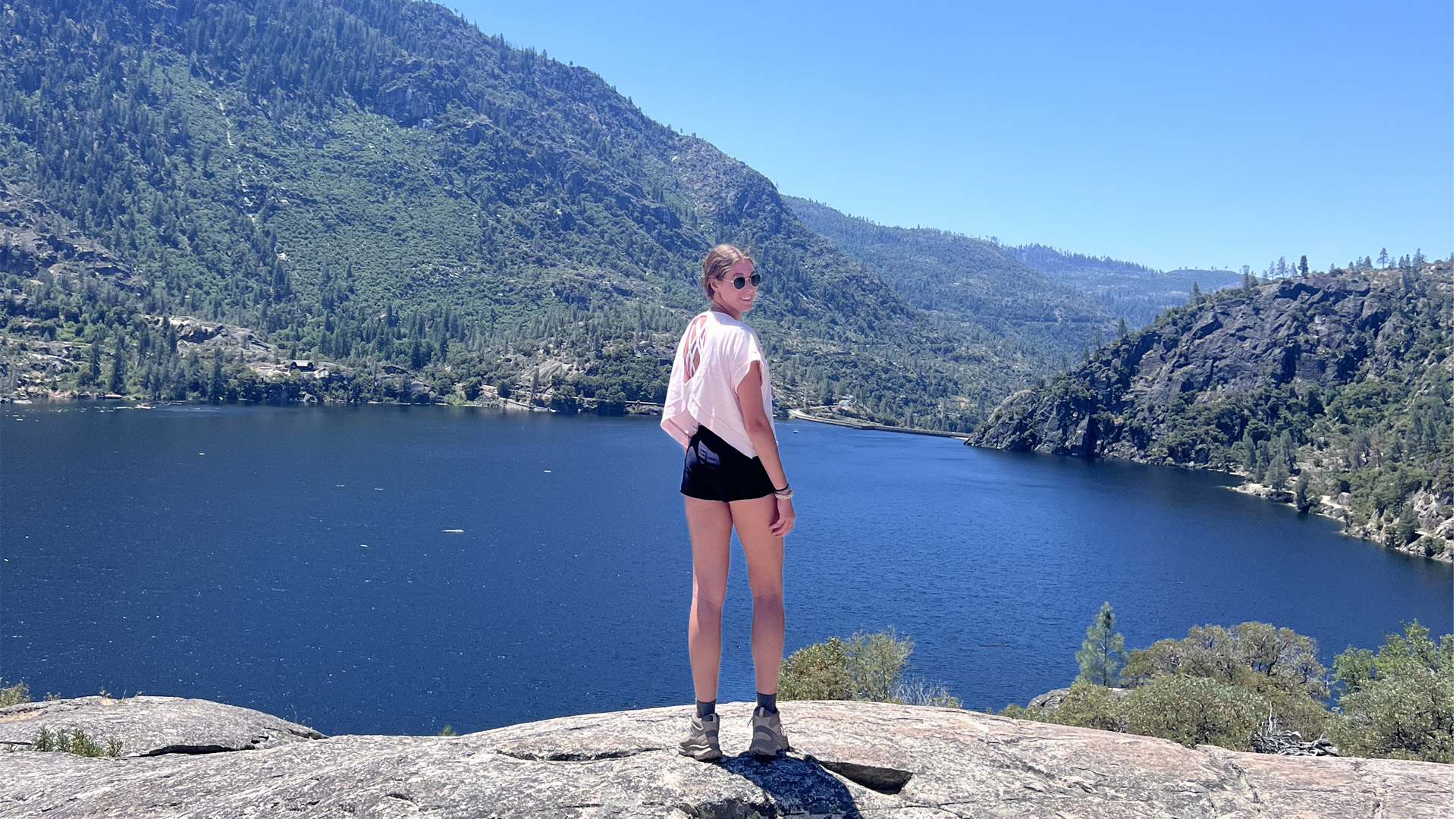
Time spent in nature can often be beneficial.
That time in the woods is quickly elevated to an educational, life-changing experience when there are two CNU professors teaching an insightful two-week philosophy class in California focused on national parks.
In the case of Lindsey Johnson, ‘26 Computational and Applied Mathematics with a concentration in Biology and Life Sciences, those two weeks studying in national parks, especially at Yosemite, helped her decide her next step.
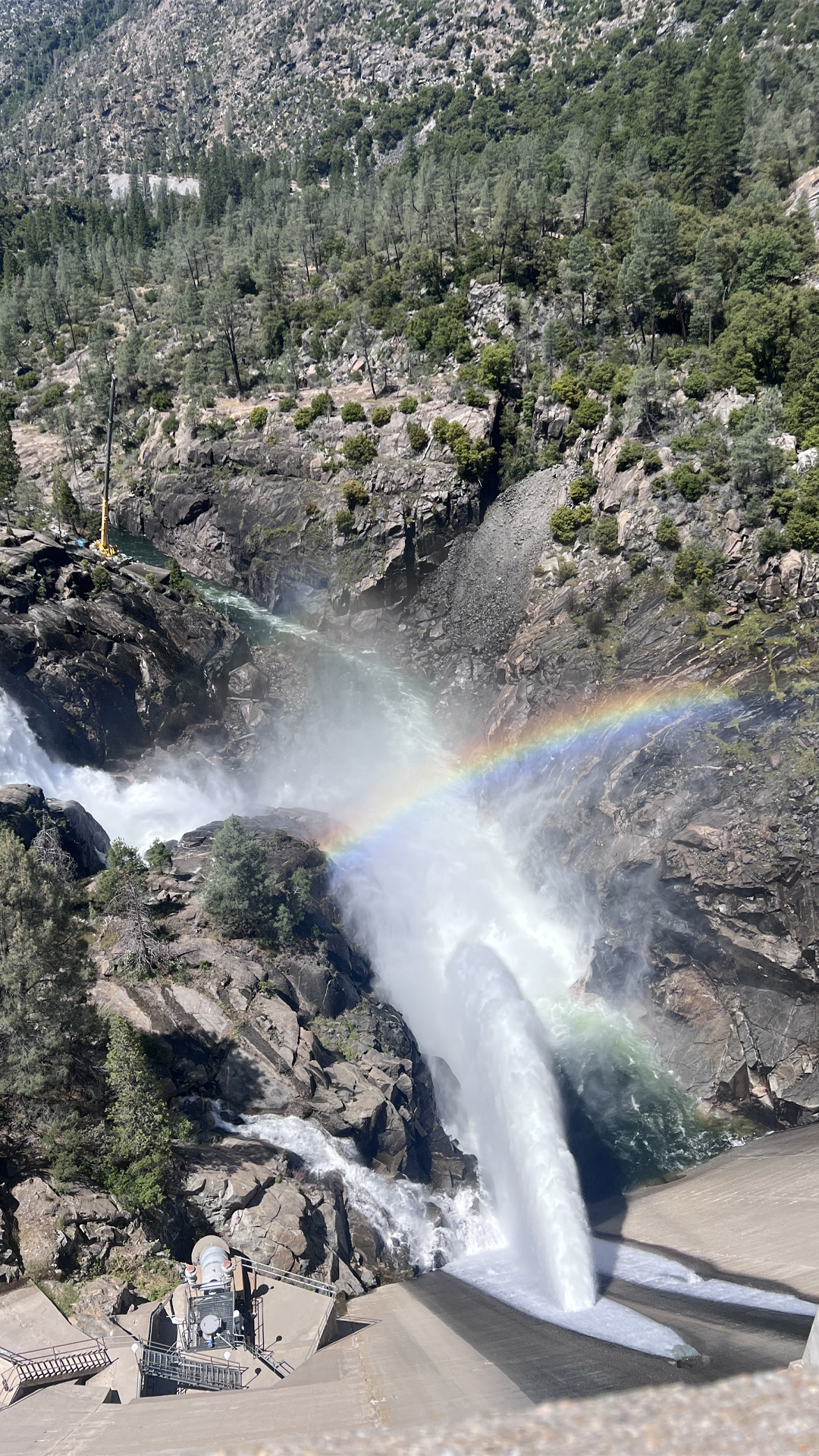
The annual summer class, called Environmental Encounters in the National Parks, was instrumental in solidifying her worldview and career trajectory. During the class, Johnson, then a junior, focused her research on the Hetch Hetchy Valley, tucked inside Yosemite, and the future of its O’Shaughnessy Dam.
What bubbled to the surface for Johnson was a passion rooted at the intersection of the environment and philosophy. The class, meant to merge thought with science, inspired her to go deeper.
She started researching and asking questions, drawing on her in-person observations and research. She looked at the bigger picture. What does the dam mean to the environment and to the nearby local community? Should it stay or should it go?
Her quest for answers resulted in her writing a paper about the feasibility of removing the O’Shaughnessy Dam in hopes of returning Hetch Hetchy Valley to its pre-dam existence. The paper, titled “Restoring Hetch Hetchy Valley: Balancing Ecological, Cultural and Urban Needs,” was nominated by the Alpha Chi Virginia Zeta Chapter at CNU for the national competition for the Sledge Benedict Scholarship. It won.
The paper, weighing the many pros and cons, concluded that the dam should eventually be removed and the Hetch Hetchy Valley brought back to its original natural state.
“While the O’Shaughnessy Dam continues to provide essential water and energy to millions in San Francisco, recent studies, advancing technology, and evolving societal values suggest that removing the dam is both feasible and beneficial in the long term. Restoration offers the potential to increase biodiversity, support the economy through tourism, honor the area’s cultural significance, and adapt to a changing climate,” the paper states.
It was not an easy recommendation to make, but one that Johnson spent a lot of time and effort studying and debating.
“This research was important because it captures how difficult it is to weigh environmental tradeoffs. Sometimes, development is necessary for a growing population to survive but that often comes at the cost of something naturally beautiful and irreplaceable,” Johnson said. “Hetch Hetchy is a perfect example of that tension and researching it helped me understand how complicated environmental decision making actually is.”
Johnson honed in on the dam conundrum when the class was asked to keep a daily reflective journal.
“What struck me most was how quiet and empty Hetch Hetchy felt compared to Yosemite, and the fact that a dam exists inside a national park,” Johnson said. “I found myself asking whether restoring the valley would actually work, or whether it could ever really be the same again.
“Since I’m interested in conservation, and policy plays a big role in how conservation decisions get made, this topic really caught my attention and felt directly relevant to the kind of work I want to do,” she said.
That type of spirited thought is what the class is designed to invoke in students. It challenges them to use philosophy and environmental science to look at various issues from diverse angles.
“Environmental problems are always philosophical problems with social, natural and scientific implications. Deciding how much risk is acceptable, what we owe future generations, whether nature has value independent of human use, and how to weigh economic livelihoods against ecological stability are not questions data alone can answer,” said Dr. Joe Balay, the philosophy professor who teaches the course along with Dr. Kip Redick, also a professor of philosophy.
Dr. Betsy Jelinek, chair of the Department of Philosophy and Religion, said the class brings to life the power of meshing different schools of thought as a foundation for problem solving.
“This significant research accomplishment demonstrates the genuine importance of interdisciplinary studies in addressing environmental issues today, and the pivotal role that philosophy plays in guiding ethical environmental action and policy,” Jelinek said.
Johnson’s research had a strong philosophical underpinning that is tempered with environmental science, the combination of which allowed her to analyze potential solutions and make informed decisions.
She is so enamored with the subject that she is now pursuing a master’s degree in environmental science from CNU. Johnson’s focus is on marine science and her thesis focuses on harbor seals and why they continue to migrate to the waters of the Chesapeake Bay and surrounding coastal waters.
What she learned in the national park class has set her on an impactful journey that offers a dynamic perspective on environmental outcomes.
“Research has really shown me how to take everything I’ve learned in the classroom and actually apply it. My career goal is to work in conservation with marine animals combining field work with data analysis,” Johnson said. “I know I want to have a career that lets me be hands-on in the field while also using data to inform conservation decisions.”