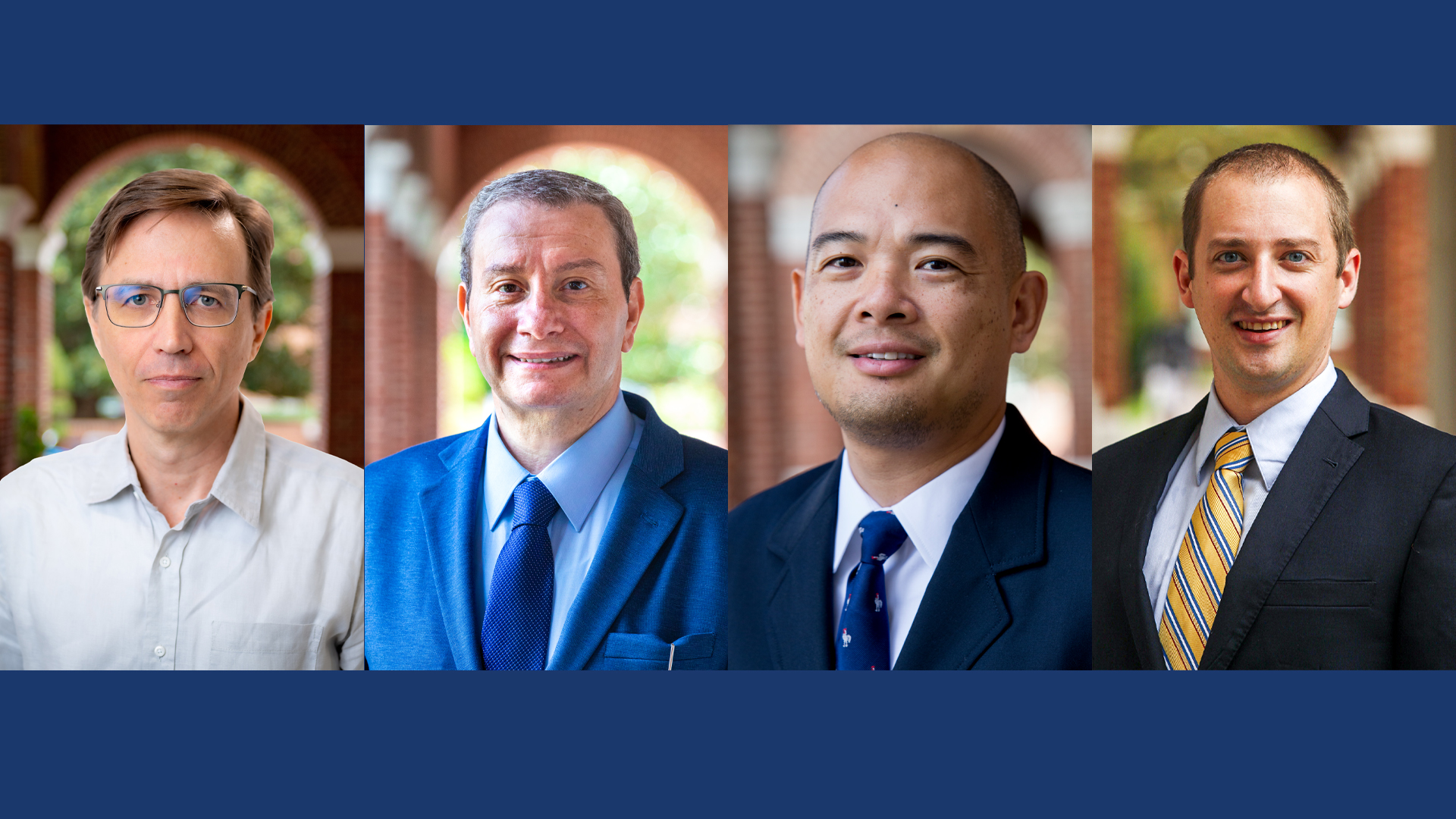
Four CNU professors have been ranked among the world’s top 2 percent of scholars and scientists in a 2026 ranking compiled by Stanford University and the analytics firm Elsevier.
Psychology professors Dr. Sherman Lee and Dr. Tim Pressley and physics research scientist Dr. Alberto Accardi all made the 2026 list based on their academic publications and citation metrics.
The ranking looks at millions of scientists globally to determine the top echelon. It is Lee’s fifth straight year in the top two 2 percent and Pressley’s fourth. Accardi was previously on the list in 2023.
Lee’s recognition was in the clinical psychology field, Pressley’s in education, and Accardi's in nuclear and particle physics.
In addition, chemistry Distinguished Professor Dr. Tarek Abdel-Fattah and Lee were recognized for career work success, the third year both have received the honor. Abdel-Fattah was recognized for his work in the field of enabling and strategic technologies and Lee in the field of psychology and cognitive sciences.
“The recognition reflects years of dedication, perseverance, and a passion for scientific discovery. I am sincerely grateful to my colleagues, collaborators, students, and institutions for their invaluable support and contributions. This achievement inspires me to continue advancing scientific research, mentoring future scientists, and making meaningful contributions to society,” Abdel-Fattah said.
Lee and Pressley were also selected by ScholarGPS as Highly Ranked Scholars for their many years of work centered on the COVID-19 pandemic. Scholar GPS grants this honor to “eminent authors whose Top Percentage Ranks places them in the top 0.05% of all scholars due to their lifetime scholarly contributions.”
Lee teaches courses and conducts research focused on the psychology of personality and the psychology of death, dying, and bereavement.
“What a great honor to be recognized in these rankings again! I am particularly happy to see that my research continues to be on the cutting edge of clinical psychology science,” Lee said. “Knowing that my contributions ultimately shape the guidelines and practices that doctors and counselors use worldwide motivates me to keep this record-breaking streak going.”
Pressley’s research is centered around the lives of educators and how best to support their well-being.
“I am honored to be recognized among the top researchers for the fourth consecutive year,” Pressley said. “I am especially grateful to the K-12 teachers who have taken the time to participate in my research and share their experiences. My hope is that this recognition reflects the importance of elevating teachers’ voices and that my research can help inform educational policies to support teacher retention.”
Accardi’s research is focused on theoretical quantum chromodynamics and Quark and gluon structure of matter.
"Exploring quantum chromodynamics is a lot like stepping into a mystery novel: Nature prevents us from directly observing the quarks and gluons inside atomic nuclei, so we have to infer their dynamic interplay by pairing fundamental theory with experimental observations of high-energy particle collisions,” Accardi said. “Unraveling these subatomic secrets takes rigorous analysis and relentless teamwork, and sharing that journey of discovery with my CNU students and colleagues is what makes the work so genuinely rewarding."
Abdel-Fattah has not only had a huge impact on the chemistry field, but has left a lasting mark at CNU as he created a groundbreaking compound that includes the University’s name. The novel chemical creation is called TAF-CNU-1. The discovery of TAF-CNU-1, a nano-scale compound, catapulted CNU’s standing in the chemistry world. It has the potential to make a positive impact on the environment.
“Imagine a sponge that can soak up harmful chemicals from polluted water. TAF-CNU-1 works like that, but on a microscopic level,” Abdel-Fattah said. “For example, it could be used in water filters to remove toxic metals or pollutants, helping provide clean, safe drinking water in communities affected by industrial waste.”
Abdel-Fattah was also the recipient of the Fulbright Specialist Program award in 2023.