Carter French and William Keeler have very little in common.
French is a student who is majoring in history. She has grown up in a time of blossoming technology. Keeler was the paymaster on the USS who survived the sinking of the Civil War ironclad ship in 1862.
They lived in different times and under remarkably different circumstances.
But their divergent worlds - thanks to an infusion of Christopher Newport’s ingenuity and creativity - are about to intersect as the past meets the present.
CNU has received a $10,000 grant from the National Oceanic and Atmospheric Administration's National Marine Sanctuary Foundation to transform the riveting story of the Monitor into a virtual reality (VR) production. Through immersive digital storytelling, Captains will be able to travel back through time and experience the Monitor final voyage in a high-tech format.
The effort is interdisciplinary, involving several academic departments.
French, '27 History, and Daniel Mayer, '29 Cybersecurity, are the two student interns chosen to help bring it from concept to reality.
French will focus on Keeler, who was a prolific letter writer during his time on the Monitor. His letters to his wife, Anna, have been preserved and will serve as a foundational piece of the virtual reality project, amplifying it with interesting facts, data, and details about the human side of what happened aboard the ship and what daily life was like for the sailors. Mayer, meanwhile, will work on the technology aspect to make the VR magic happen, scanning artifacts and helping create the visual evidence to tell the story.
"Helping bring this chapter of history to life is something I am very passionate about, and I’m excited to see the final product,” French said. “The digital humanities are important because these interactive historical projects can reach a great audience and have a real impact."
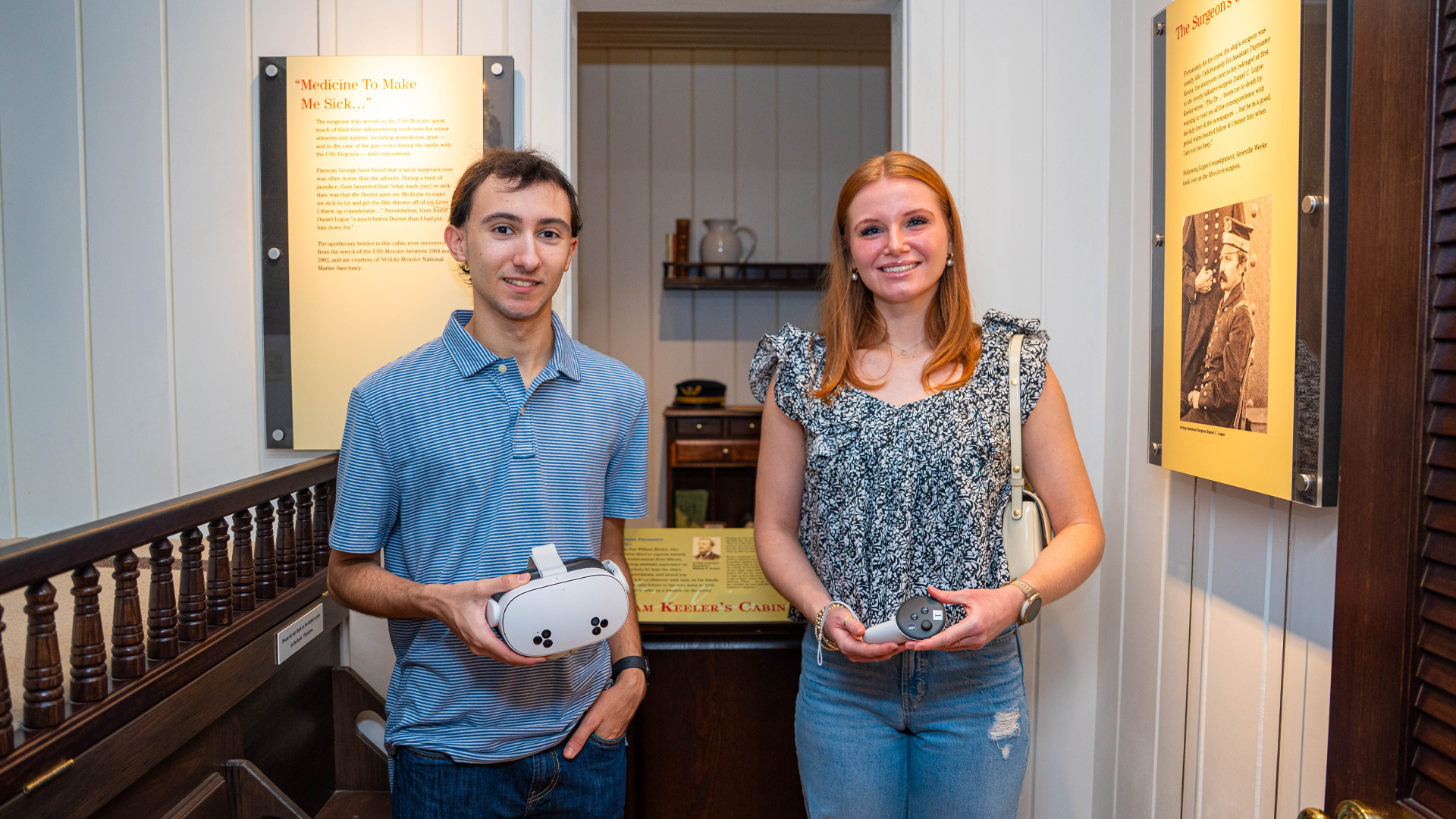
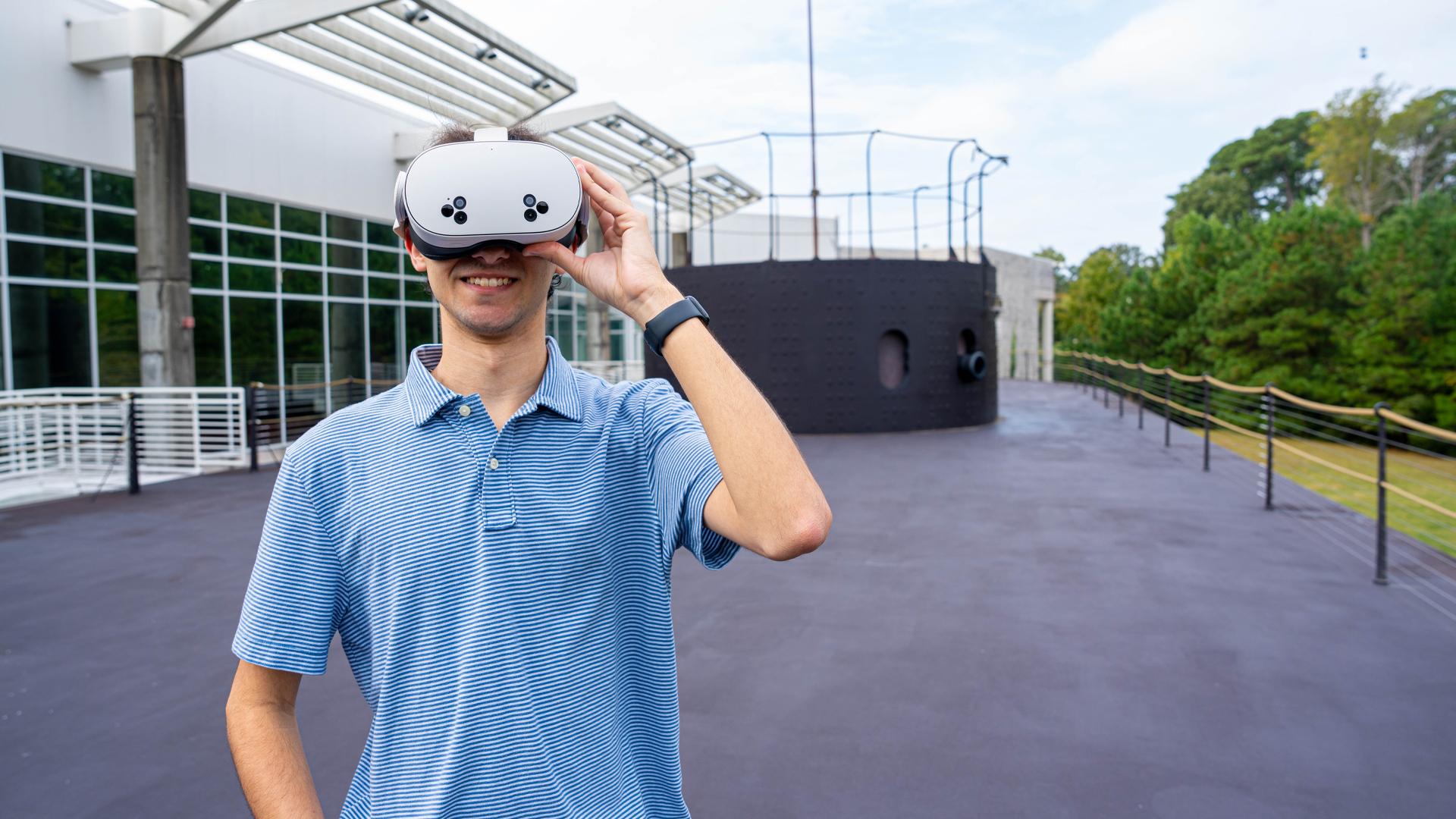
The virtual reality technology will invite viewers “onboard,” leading them through the Monitor’s interior spaces and giving them access to elements of the ship that they will be able to “touch and hold.” When they put on the VR headsets, they will get a firsthand, immersive look at the Monitor.
This project is important in telling the story of the Monitor because it was culturally significant in terms of revolutionizing warfare and the traditional notions of the crew," French said. “Being able to walk through the ship will allow a certain awe and appreciation for the innovation, but also showcase the fear that came with this technology."
It is a collaborative effort with NOAA and nearby The Mariners’ Museum and Park, which is the principal repository for Monitor's artifacts, said Dr. Andrew Falk, associate dean of Humanities and the force behind the project.
The students and faculty will focus on documentary sources (blueprints, photos, diaries), high-resolution 3D scans of artifacts housed at The Mariners' Museum, and Northrop Grumman's high-resolution sonar images of the ironclad to realistically tell the Monitor's dynamic story.
The Museum is home to the USS Monitor Center, which boasts the award-winning interactive exhibit "Ironclad Revolution" as well as the largest, most advanced conservation lab of any maritime museum. It is actively conserving thousands of Monitor artifacts and large sections of the ship’s hull, including the iconic rotating gun turret.
Mayer said he expects the project to make his time at CNU "more hands-on."
I think it's really cool that we get to take something like the USS Monitor, which most people only see in photos or behind glass, and let people actually explore it in VR. It's a mix of tech and history I don't think I'd get to work on anywhere else,” he said. “It’s one thing to learn stuff in class, but it’s different getting to work on a real project with places like The Mariners’ Museum and NOAA. Getting to be part of something people will actually use is something I’ll definitely remember."
The Monitor, which was a prototype for a highly experimental naval design that paired an iron hull with a rotating gun turret, is a major fixture of the region’s identity. Built by the Union, the USS Monitor battled the ironclad CSS Virginia (formerly the Merrimack), representing the Confederates, in 1862 in local waters.
In a practical sense, the battle had little impact on the outcome of the Civil War, but it marked the first ever combat between ironclad warships and contributed to many of the world’s most advanced navies transitioning from traditional warships toward the modern naval fleets of today,” Falk said.
The Monitor ultimately sank during a storm that same year and was discovered 111 years later, in 1973, in deep water by researchers from Duke University.
The ship also gives us insights into the stories we can preserve. For example, the crew was made up of young men fighting to preserve the Union, European immigrants seeking citizenship rights and economic opportunity, and Black crew members fighting to end the system of slavery, Falk said. “Keeler’s words, brought to life in VR, will help interpret that dramatic and important story for a new generation in an accessible, interactive, and educational way.
CNU professors from various departments are coming together with diverse fields of expertise, perspectives, and knowledge to power the project. Falk, Computer Science Professor Chris Kreider, and Theatre Professor Ryan Bible will form the foundational faculty team - working with the students and staff from NOAA and the museum on the historical, technical, and theatrical elements that meld together to produce VR.
For Christopher Newport, another benefit of this project is to demonstrate the enduring power of the liberal arts by connecting with our community. This grant-funded project brings together students and faculty from different disciplines. Working closely with faculty mentors, students gain practical, hands-on experience that develops essential skills with cutting-edge digital technology,” Falk said.
CNU has made virtual reality a showcase of its high-tech digital humanities program with its on-campus VR lab, which gives students and faculty access to a wide variety of experiences, from walking tours of faraway lands to historical experiences, such as being in Anne Frank’s annex in Amsterdam. It offers the CNU community a front-row, interactive 3D introduction to people and places across the globe that they otherwise may only read about in textbooks and learn about in classrooms.
By building a state-of-the-art virtual reality lab, housing it within the humanities departments, and empowering the Institute for Public Humanities to lead the way, CNU has fostered a collaborative ecosystem where our students, interdisciplinary faculty, and community members work together,” Falk said. “In many ways, the Monitor Project represents the essence of Christopher Newport University's reputation that combines innovation with meaningful public purpose.
The Monitor endeavor, French, said, has been instrumental in both elevating her CNU education and in helping her forge her career path.
This project has already impacted my experience at CNU as I near the end of my time at the University. It has been an honor to be a part of this project and have hands-on experience in this internship,” she said. “I think this will also help prepare me for the job market I will be entering soon and equip me with a set of skills to help me succeed.”