When Charlotte Costic ‘27 saw panels from the AIDS Memorial Quilt on campus, she became emotional.
“I felt like the grief was literally tangible in that space, probably because the panels have such personal details and I get to experience those details without experiencing the person that they belong to,” she said. “I think it was a really powerful moment just about how grief is universal and to feel is human.”
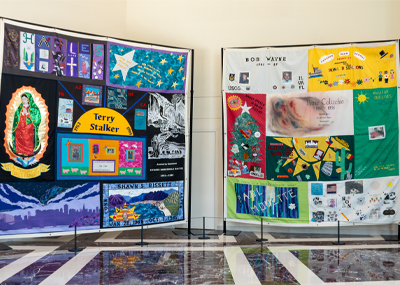
The quilt, created in memory of AIDS victims, now travels the country. Each square on the panel is a personal memorial, putting a human face on the epidemic that started in the 1980s and has since killed more than 40 million people globally.
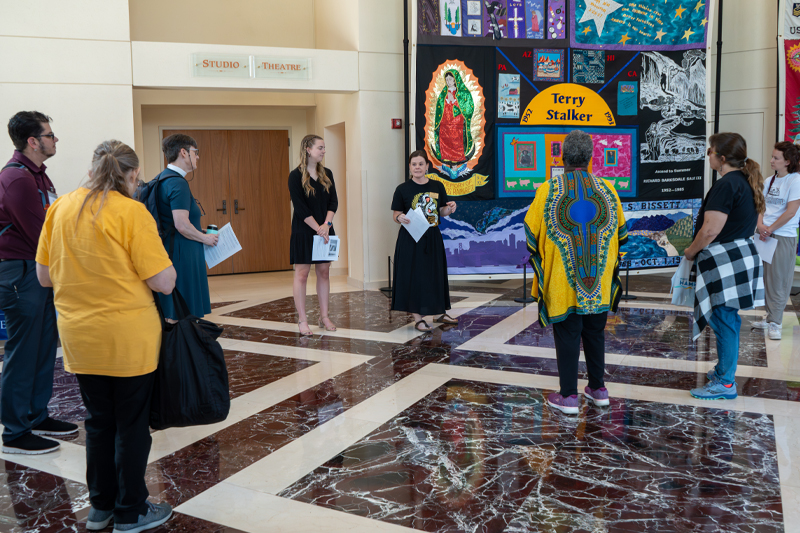
Several of the panels recently arrived at Christopher Newport, and the community rallied around them, incorporating their history and meaning into class and universitywide discussions and projects.
One of those classes was English 411: Literacies and Communities. Dr. Brooke Covington, assistant professor of English, wove the quilt into her teaching and made it a primary case study. The focus of the class is community literacy and public memory.
“Essentially we’ve explored how communities use reading, writing, storytelling, and public art to shape collective memory about difficult histories. Whose stories get preserved in public space and whose are forgotten or erased? And just as importantly, who gets to decide?” said Covington, also the academic director of the Center for Community Engagement. “The AIDS Memorial Quilt is one of the course’s primary case studies. The timing of the AIDS Memorial Quilt arrival on campus is deeply meaningful to the course.”
To create a parallel to the AIDS quilt, Covington challenged her students to design a class quilt as the “final course reflection.”
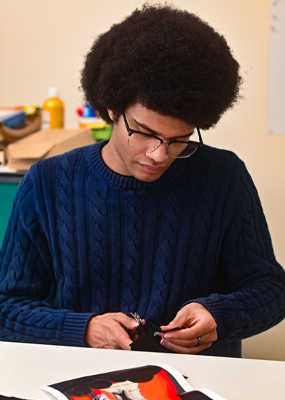
“Each student created their own quilt square that reflects their thinking about the course themes of public memory, contested histories, and community belonging," Covington said.
The 12-by-12 squares were then sewn together by Debbie Moore, a volunteer from Mary M. Torggler Fine Arts Center.
“Many of their quilt squares are symbolic and personal to them - commemorating a facet of their lives that they want to memorialize. Others are commenting on local histories," Covington said. “For example, one student’s square represents Endview Plantation, where we went on a class field trip to reflect on whose histories are represented in Southern plantation homes and whose are erased or avoided.”
For Costic, an English major in the class, making the connection between the AIDS quilt and the class quilt was a defining moment, allowing her to view her personal journey in a different light. Being able to express her thoughts through her own quilt square not only brought her own experiences to life, but also provided a tangible way to show what she has ascertained from the course.
“Making these panels has been so special,” said Costic, who learned to sew as part of the class.
Costic’s square depicts a yellow and pink tulip flower, which represents her time as a Leadership Adventure facilitator for the President's Leadership Program.
“Leadership Adventure has been a really big part of my CNU journey. And working for PLP helped me grow so much so I knew I wanted to include that! The words around the flower are ‘those who look to him are radiant,’ which comes from Psalm 34:5,” Costic said. “My faith is the biggest part of my identity, so I know I wanted to include that.
“One thing that was going through my mind a lot was thinking about my personal identity as a Protestant, evangelical Christian working on a medium that’s in remembrance of the AIDS Memorial Quilt. I think it’s easy to look at two identities that might seem automatically in contrast or conflict with each other and quite literally weave them together,” she said. “It was very special to be able to hold that tension and work on this project. My religious identity is really important to me and so is being able to hear and learn from people with different experiences and opinions than me. Getting to learn those things because of a class on public memory is truly so special.”
That sort of connection is exactly what Vice Provost Dr. Lori Underwood was hoping would happen when she worked diligently to bring the quilt to CNU. She had seen the quilt at her own college student’s theatre production at another university, and said the “visual and emotional impact of these panels was immediate.”
“As a parent of one of the members of the theatre troupe, the moment hit incredibly close to home. Seeing my child - a member of the LGBTQ+ community - experience the weight and beauty of the quilt was a transformative experience. But the impact didn’t stop there; it rippled through the other students and the entire audience, leaving a heavy and reverent silence in its wake,” said Underwood, also a professor of Philosophy.
She knew immediately that she wanted to cultivate the same experience at CNU.
“In a society constantly overwhelmed by new, looming dangers, maintaining the collective memory of the AIDS epidemic - both nationally and globally - has become increasingly difficult,” Underwood said. “Yet, watching a new generation of students, who had recently navigated the isolation of COVID-19 pandemic stand before the physical remnants of another historical crisis, a powerful realization set in. The stories stitched into the fabric of the quilt needed to be shared closer to home. I want our students who have lived through a global pandemic, and our LGBTQ+ students, staff and faculty to have the opportunity to interact with the quilt. I want our community to recall, or learn for the first time, what people experienced as victims or survivors.”
Underwood’s vision came to life, as the quilt was not only used in classes, it was also hung outside the theatre in which “The Laramie Project," a play about the violent death of gay student Matthew Shepard, was being performed. The presentation of the quilt was titled “Woven Together: A Celebration of Life and Awareness.” In addition to the national quilt squares, the LGBT Life Center in Hampton contributed locally-made panels to the display.
“It goes beyond historical reflection. While it serves as a vital educational bridge, reminding the community of the engine realities of the AIDS epidemic, its core mission is one of radical inclusion,” Underwood said. “It is a tangible, visual way to wrap the community in support and send a clear, unwavering message to the LGBTQ+ students, staff, and faculty: You are seen, you are heard, and you are entirely embraced.”
Dr. Laura Puaca, director of the Program in Women, Gender, and Sexuality Studies, organized a screening of the film, “Common Threads,” an Academy Award-winning documentary about the quilt, followed by a panel discussion featuring community members. These activities added perspective to conversations around the quilt taking place on campus.
“We hope to create space for sharing stories, building empathy, and having honest conversations about HIV/AIDS,” Puaca said. “I am also hopeful that audience members came away with a better understanding of resources available and efforts to effect change in our local community.”
The multitude of events the quilt inspired on campus, she said, “speaks volumes about the CNU community’s willingness to have hard conversations about topics that still carry stigma while fostering a climate of inclusivity.”